
Loading
The fastest crash and the fastest recovery in the dataset, in a single cycle
Published by The Retail Trader · OCT 18, 2021 · Case Studies
The COVID crash was half as deep as 2008, but four times as fast. From the 14 January 2020 peak to the 23 March 2020 trough took only 69 trading days, and the Nifty fell 38.4%. What happened afterwards was even faster.
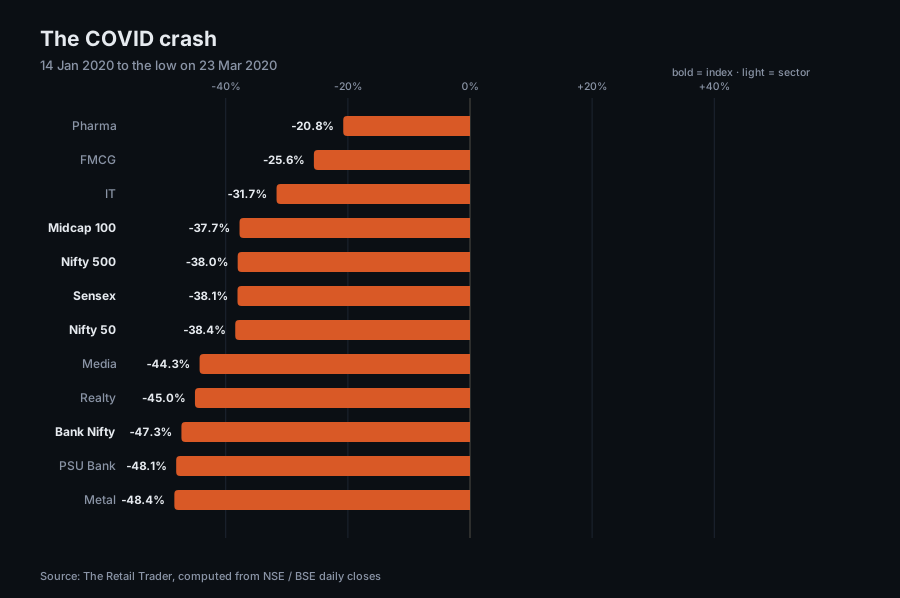
Peak to trough:
• Pharma — -20.8%, the smallest loss
• FMCG — -25.6%
• IT — -31.7%
• Midcap 100 — -37.7%
• Nifty 500 — -38.0%
• Sensex — -38.1%
• Nifty 50 — -38.4%
• Media — -44.3%
• Realty — -45.0%
• Bank Nifty — -47.3%
• PSU Bank — -48.1%
• Metal — -48.4%
A big difference from 2008: this time sector selection actually made a difference. Pharma and FMCG lost 12 to 18 points less than the Nifty. These are the two sectors with the lowest volatility in the whole dataset — 18.4% and 16.5% annualised.
On the other side, Metal, PSU Bank and Bank Nifty lost 47-48%. These are the same three that are in the most volatile group in our sector risk study.
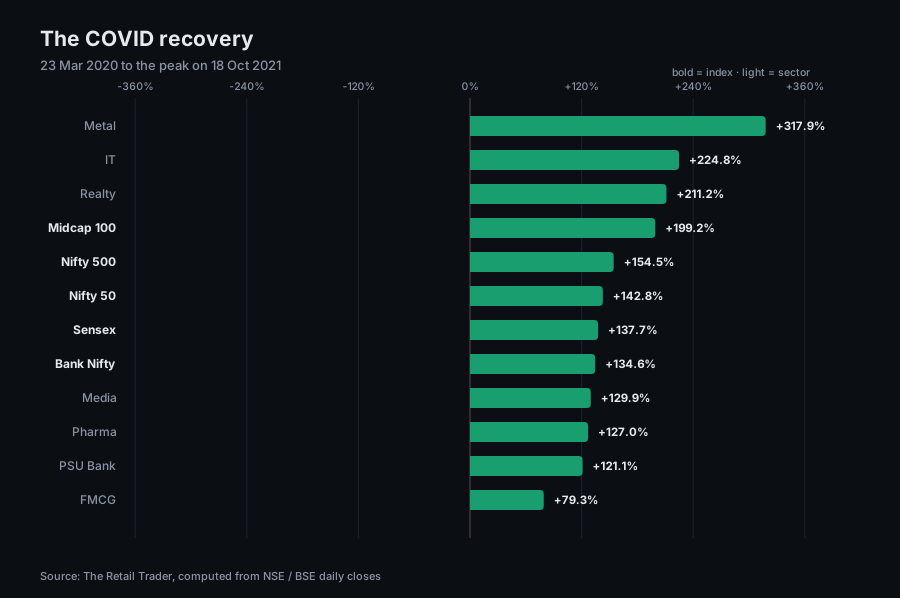
Trough to next peak:
• Metal — +317.9%
• IT — +224.8%
• Realty — +211.2%
• Midcap 100 — +199.2%
• Nifty 500 — +154.5%
• Nifty 50 — +142.8%
• Sensex — +137.7%
• Bank Nifty — +134.6%
• Media — +129.9%
• Pharma — +127.0%
• PSU Bank — +121.1%
• FMCG — +79.3%
Metal was the worst in the crash (-48.4%) and the best in the recovery (+317.9%). FMCG was the second best in the crash (-25.6%) and the worst in the recovery (+79.3%). The whole ladder turned upside down.
This cycle is the clearest example of the trade-off in defensive investing. Someone who stayed in FMCG saved 13 points in the crash and gave up 63 points in the recovery. Net, over the whole cycle, they stayed well behind.
This does not mean defensive is wrong — it is not that. It means that the benefit of being defensive is only received when you stay invested through the decline. Someone who sold in the crash too took the bad part of both sides: sold cheap and bought back expensive.
And one more number: 23 March 2020 was the worst day in the entire dataset (-12.98%). Two weeks later, on 7 April 2020, came the second-best day (+8.76%). Those two days were 15 sessions apart.
All figures in this article are computed from The Retail Trader's own daily index database, as of 24 July 2026. Past performance is no indication of the future, and this analysis is for educational purposes only — it is not a buy or sell recommendation.