
Loading
19 years of data: the entire gap between the five days is one-fifth of one percent
Published by The Retail Trader · JUL 24, 2026 · Weekly Outlook
'The market falls on Monday', 'Profits get booked on Friday' — these claims are found in every trading group. We split the Nifty's 4,622 sessions by weekday to see how much substance they have.
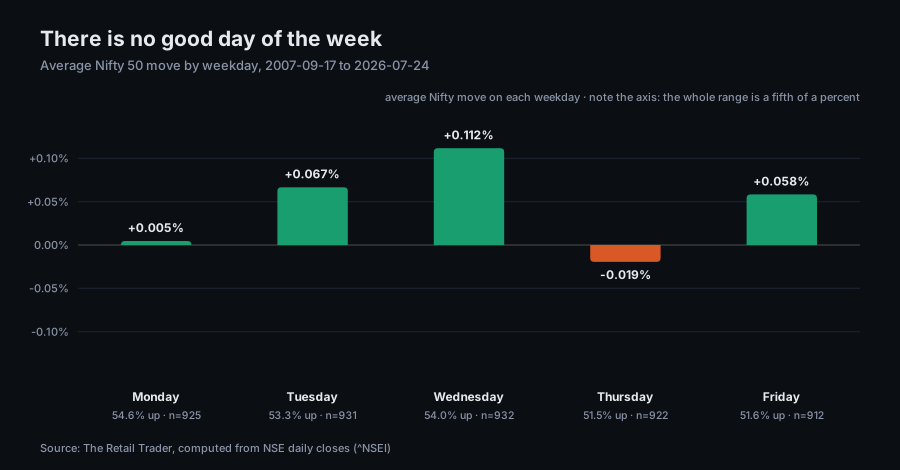
Average daily move and positive-day rate:
• Monday — +0.005%, 54.6% of days green (n=925)
• Tuesday — +0.067%, 53.3% green (n=931)
• Wednesday — +0.112%, 54.0% green (n=932)
• Thursday — -0.019%, 51.5% green (n=922)
• Friday — +0.058%, 51.6% green (n=912)
The difference between Wednesday (+0.112%) and Thursday (-0.019%) is 0.131 percentage points — per day. The brokerage, STT and other charges of a round-trip trade are often more than this.
That is, if you make a rule like 'buy Wednesday, sell Thursday', the edge you are trying to capture is smaller than your transaction cost. Even if this edge exists, it is not possible to make money from it.
The highest positive-day rate is Monday's (54.6%) and the lowest is Friday's (51.6%). A three percentage point difference on 900+ observations — this is too small to be statistically meaningful, and practically useless.
Note that Monday's average return is almost zero (+0.005%) while its hit rate is the highest. That means that on Monday small wins are more frequent, and big losses too. That is not a tradeable pattern either.
Its job is to remove a belief, not create a new one. Every week people change position size or entries according to the day; according to this data there is no basis for it.
The things that have actually turned out to be meaningful in this dataset — monthly seasonality (January -1.27% average vs April +3.26%), the VIX regime, and sector rotation — are all far above the day level. At the day level there is only noise.
All figures in this article are computed from The Retail Trader's own daily index database, as of 24 July 2026. Past performance is no indication of the future, and this analysis is for educational purposes only — it is not a buy or sell recommendation.